
NHS Workforce, Training and Education (WT&E)
The Workforce, Training and Education (WT&E) directorate of NHS England (NHSE) ensures the NHS in England has a sufficient and inclusive workforce with the knowledge, skills, values and behaviours to deliver compassionate high-quality health and care to the people it serves.
You can find a range of workforce offers and support on their main website.
NHS Long Term Workforce Plan 2023
The long awaited NHS Long Term Workforce Plan maps out a strategy to recruit and retain many thousands more staff spanning 15 years.
The plan has specific measures to support and develop the pharmacy workforce, and has given specific consideration to community pharmacy in recognition of what it describes as the sector’s ‘unique circumstances’.
Recent pharmacy specific offers & information are listed below:
In December 2024 NHS England announced that multi-sector rotations during the 2026/27 Foundation Pharmacist Training Programme will not now be mandatory.
Multi-sector rotations involve at least 13 weeks of training in a different area of pharmacy practice to the one the trainee is based in. Following the publication of the General Pharmaceutical Council’s Standards for Initial Education and Training of Pharmacists (2021), NHS England mandated that multi-sector rotations would be required for all trainees starting in the 2026/27 training year.
However, mindful of the current pressures faced by pharmacy teams and the broader healthcare sector and to support pharmacy teams in continuing to deliver high quality training, NHS England has decided that mandatory rotations will be delayed and a phased approach will instead be implemented.
Read more about this in NHS England’s letter announcing the change
The NHS England Workforce, Training & Education team has launched the latest National Recruitment Scheme for Foundation Trainee Pharmacists.
All training places are allocated exclusively through Oriel, ensuring a fair and transparent national process. THE PORTAL IS NOW CLOSED.
For your information
The Foundation Pharmacist Programme had a hard deadline of midday on Tuesday 3rd March 2026 for completed applications to this Programme in the Oriel portal.
You can access the Oriel Recruitment workshop slides here
New updates for 2026 include changes to employer registration deadlines and revised Terms of Participation.
Explore the National Recruitment Scheme overview and view full details of the opportunity and registration process here.
If you have any questions about The Recruitment Scheme or the process please do not hesitate to contact the Oriel team.
There is funding available to all foundation training sites hosting a foundation trainee pharmacist in England. 2026-27 funding details. NHS England announces funding uplifts for pharmacy trainees – Community Pharmacy England 2027-28 Details have not yet been released.
You will find all the information you need in the CPE Website
Fully funded independent prescribing training is now available for pharmacists across all sectors, including community pharmacy, locum practice, general practice, health and justice, and hospital settings.
Courses are delivered by a range of approved universities across England, with several intake dates available through to March 2027.
Click the link to request further information – Independent Prescribing for Pharmacists funded courses post March 2026
Here you can find out more about those on the National Approved suppliers list
This training supports the continued expansion of pharmacy’s clinical role, enabling pharmacists to deliver care across the full pathway – from clinical assessment and diagnosis through to prescribing, patient advice, and follow‑up.
Full details are available via NHS England.
The Teach and Treat programme has been expanded to all seven NHS England regions for 2025/26, helping community pharmacists complete their independent prescribing training in supported clinical settings.
Run through various regional partners, the initiative aims to create more sustainable supervision arrangements while improving access to designated prescribing practitioners for community pharmacists.
Further details are available on the NHS England website and the NHS Futures platform.
In Norfolk and Suffolk we have 6 people working in the 2025-26 Teach and Treat Programme.
The East of England Teach & Treat Clinical Supervision Pilot
A Designated Prescribing Practitioner (DPP) is a qualified healthcare professional in Great Britain or Northern Ireland who holds independent prescribing authority. They oversee and support a trainee during their independent prescribing (IP) training and are responsible for confirming that the trainee is competent to prescribe safely.
This supervisory role is no longer limited to doctors. Any qualified independent prescriber—such as a doctor, nurse, or allied health professional (AHP)—can act as a DPP.
You will find all you need to know in the HEE Website
Update
Funding outcomes for the Community Pharmacy Technician Apprenticeship Programme (CPTAP) have now been issued. Pharmacies that applied should check their email inboxes (including spam folders) and take any required action as soon as possible. Successful applicants must accept their funding offer by the stated deadline to secure their allocation. The programme provides significant funding to support Pharmacy Technician apprenticeships and workforce development within community pharmacy teams.
Key actions: Review your funding notification, accept any offer received, and begin planning recruitment and enrolment activities for approved apprentices.
Support Available
Pharmacy owners who have secured funding are encouraged to speak with their preferred apprenticeship training provider to discuss the support available throughout the apprenticeship journey. Many providers can assist with recruitment, enrolment, training delivery and meeting programme requirements.
Employers may also be eligible for additional apprenticeship incentives and funding opportunities.
- £1,000 young apprentice payment
- £3,000 youth jobs grant
- £2,000 non-levy hiring grant (from October 2026)
- Potential National Insurance relief for eligible apprentices under 25
Before making any decisions, pharmacy owners should review the latest eligibility criteria and funding arrangements to identify the support available to their organisation.
ORIGINAL OFFER 2026
This programme supports Pre-registration Trainee Pharmacy Technicians (PTPTs) to be employed and complete a two-year apprenticeship training programme within a community pharmacy setting. On successful completion of training and registration with the General Pharmaceutical Council (GPhC), pharmacy technicians will be well placed to support service delivery and wider healthcare priorities within community pharmacy.
Full details for contractors are available in the contractor guidance documents. These can be accessed as both a PDF and an accessible Word document.
The contractor guidance outlines how the programme works, including who is eligible to take part, the key timescales, available funding, and the benefits for community pharmacies.
Application of Funding (AoF) requests must be submitted via the Community Pharmacy Technician Apprenticeship Programme (CPTAP) 2026 East of England online application form. The deadline for applications is Monday 18th May 2026, at midday.
You can find further information about the apprenticeship providers available by clicking here.
NHSE are offering a financial training contribution of £15,505 per PTPT, per year for the two-year training period. Update Sept 2026 NHS England announces funding uplifts for pharmacy trainees – Community Pharmacy England This contribution supports sites in developing an employer-led, work-based training programme that meets GPhC initial education and training (IET) standards for pharmacy technicians and the NHS England Education Quality Framework (accessed via the National School of Healthcare Science website).
Further programme information, is available on NHSE website
If you have any questions, please email england.wtepharmacy.eoe@nhs.net with “Community Pharmacy Technician Apprenticeship Programme 2026” in the subject field.
NHSE WT&E have published the Pharmacy Technician Workforce Development Programme document (Nov 2024).
The Pharmacy Technician Workforce Development Programme document aims to enhance the training, recruitment, retention, and professional development of pharmacy technicians in England to support the delivery of the NHS Long-Term Workforce Plan. Key goals include addressing workforce shortages, enabling healthcare reforms, and improving healthcare services across settings.
Additional government funding is now available, from 1st October 2026 to support non-levy employers looking to grow their team through apprenticeships. This initiative forms part of the Government’s wider effort to expand the Youth Guarantee and create 50,000 more apprenticeships for young people across the UK. New Non-Levy Hiring Grant (£2,000) Starting from October 2026, non-levy-paying employers (Employers with a wage bill under 3 million annually) can claim a £2,000 hiring grant when recruiting an additional apprentice aged 16–24. Key details of the grant: For example: Payments This is paid to the training provider, where it then gets passed on to the employer: Further funding support With up to £6,000 available per apprentice, training providers can support you with further government funding streams, including: Young Apprentice Payment of £1,000 This is paid to the training provider, where it then gets passed onto the employer: This is paid directly to the employer (subject to DWP checks): Talk to your training provider about the support they can offer with apprentice funding.
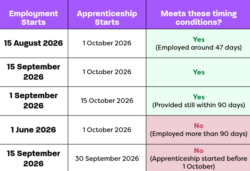
What is an apprenticeship? An apprenticeship is a paid role where an employee works whilst completing a structured training programme that leads to a recognised qualification or professional role. In pharmacy, apprenticeships can support both new staff entering the workforce and existing team members developing into more advanced roles. What are the advantages of this route for training and development? Apprenticeships can help pharmacies to: Do I need to employ the person as an apprentice if I am going to pay apprentice rates? Yes. If someone is being employed on apprentice terms or apprentice pay rates, they must: Does that mean I do not need to continue to employ them at the end of the apprenticeship? There is no legal requirement to retain an apprentice once they complete their apprenticeship, unless otherwise agreed contractually. However, many pharmacies do retain apprentices as they are already trained within the business. What programmes are available for pharmacy teams? Examples of apprenticeships relevant to community pharmacy include: A key current programme is the Community Pharmacy Technician Apprenticeship Programme, which supports trainee pharmacy technicians completing a 24‑month apprenticeship in community pharmacy. How do I find the right apprenticeship programme for my pharmacy? Consider: Support is available from: How do I get an apprentice? You can either: Typical steps include: How does the funding work? Apprenticeship funding generally supports the training costs, not the salary costs. The employer continues to pay the apprentice’s wages through payroll. For most community pharmacies (non‑levy employers): In some cases, levy transfer arrangements can cover 100% of training costs. What are the different levels of funding depending on the apprentice? Funding depends on the apprenticeship standard and level. For example: The current NHS England Community Pharmacy Technician Apprenticeship Programme provides significant additional training support funding for eligible pharmacy contractors. How do I access funding alongside an apprenticeship? Funding is generally accessed through: Additional support may also be available through NHS apprenticeship levy transfer schemes. Does the funding pay the apprentice directly or do I? The employer pays the apprentice directly through normal payroll arrangements. Apprenticeship training funding is paid separately towards the training provider costs via the Apprenticeship Service system. Are there any Apprenticeship Funding Rules? Yes Apprenticeship funding rules and assessment plan guidance, 2026 to 2027 – GOV.UK